
Samadhi
What is Samadhi?
Attaining enlightenment in a living body is called Samadhi.
What is Samadhi in Patanjali Yoga?
On the path of Yoga, you move from Yama to Samadhi. Yoga, that is the union with the Divine, culminates in Samadhi. Patanjali calls this Kaivalya Samadhi.
What is Samadhi in Tantra?
On the path of Tantra, it happens to you in Sahasrara. On the path of Tantra, you move from Muladhara to Sahasrara. In Tantra, Samadhi happens to you in Sahasrara.
What is Samadhi in Sankhya Yoga?
On the path of Sankhya Yoga, you will discover Samadhi in the union of Prakriti and Purusha. Matter and Consciousness are two different things. They are two different aspects of the same reality. Matter is frozen, and consciousness is alive. In science, when we go into the depths of matter, we find that there is nothing called matter. In the quantum realm, there is nothing like matter. Everything is fluid and dynamic. The so-called particles are the collapse of a wave function. Nothing is made of particles. Everything is made of quantum fields. Matter is a perceivable aspect of that reality, and consciousness is a non-perceivable aspect of the same reality. So, on the path of Sankhya Yoga, Samadhi happens to you in the experience of the union of Prakriti and Purusha. There can be many paths, but the goal is one. It is like mathematics. In mathematics, there can be many methods or ways to solve the problem, but the solution is always one. The same is true in spirituality.
Atman and Brahman
In Samadhi, you discover your own Soul (Atman). In this experience, you also realize that the Atman (soul) is a subset of the Paramatman (Brahman). Your ultimate realization culminates in the Brahman, the non-dual reality. Now you are one with the Divine. And all duality has just vanished.
In the field of science, you are called an observer. As an observer, whatever you see is an observed reality and not the existential reality. You can never discover your soul through science. Science is for an observer. It is objective, mathematical, empirical, and experimental. It is an outer journey. Spirituality is for a witness. It is subjective and experiential. It is subject to your own existential experience. It is an inner journey. Working with the mind is part of science, and working on the mind is part of spirituality. In spirituality, you move from your mind to your consciousness, and from your consciousness to the Supreme Consciousness. And the method you use in the whole process is mindfulness and meditation.
Mahasamadhi
When an enlightened person dies, it is called Mahasamadhi. Some people refer to the act of consciously and intentionally leaving the body as Mahasamadhi. This is a fallacy. This is criminal. This act is not Mahasamadhi. This act is suicide.
Nirvana
In the language of Buddha, Nirvana means Samadhi. In Buddhism, Nirvana is the same as Samadhi.
Mahaparinirvana
This is the same as Mahasamadhi. When a Nirvanic person dies, it is called Mahaparinirvana. When Buddha finally dies and leaves his body, it is called Mahaparinirvana.
So, Samadhi and Mahasamadhi have nothing to do when a monkey or donkey dies.
Note
Note
In the field of science, you are called an observer. As an observer, whatever you see is an observed reality and not the existential reality. You can never discover your soul through science. Science is for an observer. It is objective, mathematical, empirical, and experimental. It is an outer journey. Spirituality is for a witness. It is subjective and experiential. It is subject to your own existential experience. It is an inner journey. Working with the mind is part of science, and working on the mind is part of spirituality. In spirituality, you move from your mind to your consciousness, and from your consciousness to the Supreme Consciousness. And the method you use in the whole process is mindfulness and meditation.
Quote
What is Meditation?
Meditation is a process of witnessing yourself. But how will you witness yourself? Because yourself means the whole of you. Discovering the whole of you (Poorna) is the culmination of meditation. So you have to start to reach that goal. You have to begin witnessing from your breath and thoughts. And then you have to move to your feelings. And from there you will reach the centre of your being. You will witness your soul (Atman) at the center of your being. Meditation is basically a process of witnessing yourself at the three levels of your being without judgment. You have to witness your actions, thoughts, and emotions without judgment. The transformation is a consequence. It will happen on its own.
Gallery

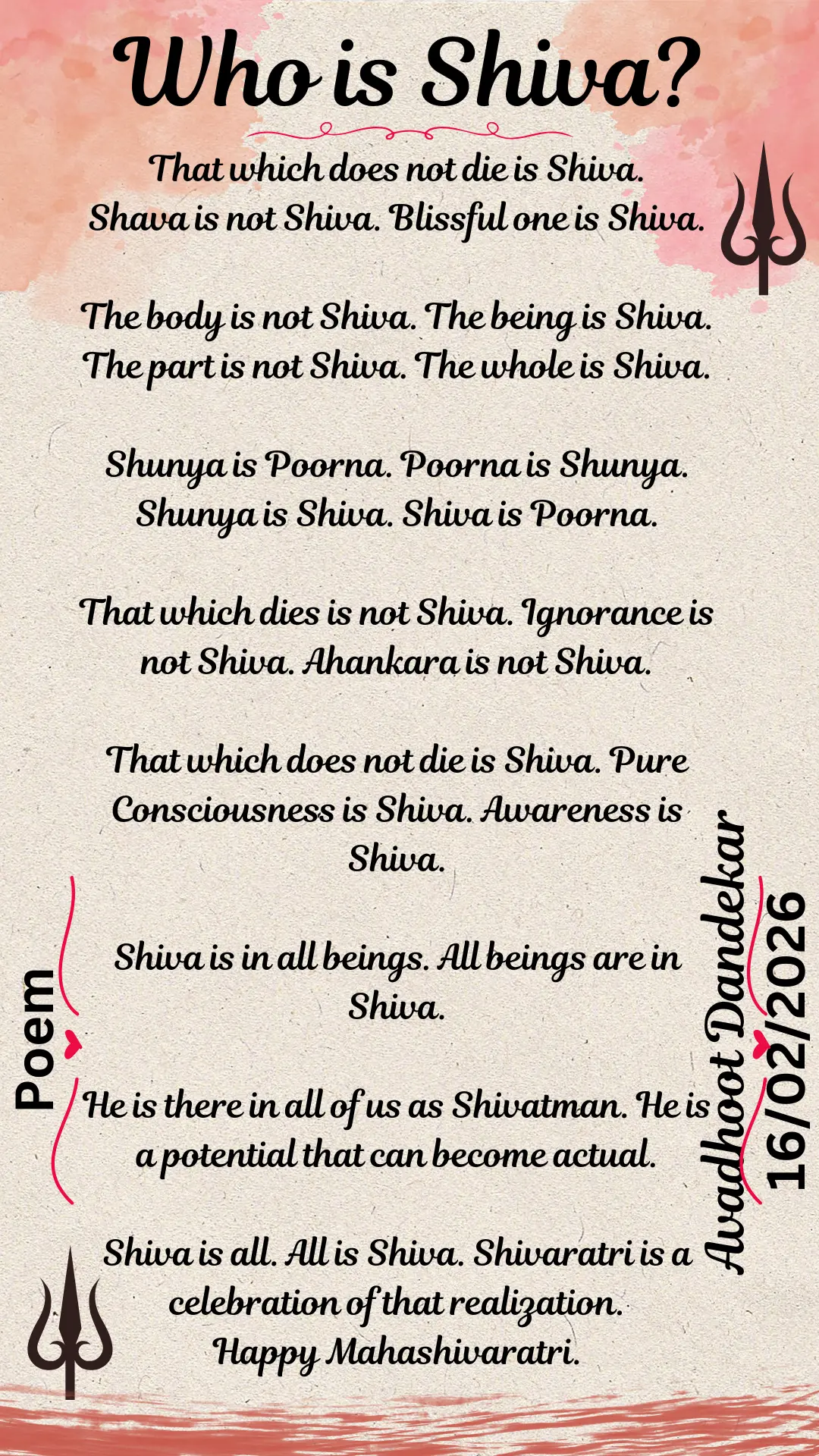
Sanskrit Words
Shunya: Zero, Void, Empty, Infinite Potential.
Poorna: Fullness, Completeness, Wholeness, Nothing Beyond.
Ahankara: Ego, False identification of the true self (Atman) with the body, mind, or intellect.
Shivatman: The true Self (Atman) in each one of us.
Nama, Rupa: Names and Forms. Shiva is beyond Nama and Rupa.